

Whole-Home Repiping in St. George, UT
When your pipes have reached the end of their useful life, Marlin Plumbing replaces every supply line in your home from the main shutoff to the fixtures — cleanly, quickly, and with materials designed to outlast Southern Utah's hard water.
Get a Free Estimate
We'll call within the hour.
No spam. Licensed & insured. Free estimates, always.
47+
Years
Serving Southern Utah
Certified
Technicians
Industry-Trained Pros
4.9
Star Rating
500+ Google Reviews
24/7
Available
Emergency Response
100%
Licensed
& Fully Insured
Free
Estimates
No Hidden Fees Ever
Complete Home Repiping Services for Washington County
A whole-home repipe is the most comprehensive plumbing project most homeowners ever undertake — and in Southern Utah, where hard water accelerates pipe aging and expansive clay soil stresses buried lines, it's a project that a significant percentage of homes built before 1995 will eventually need. Marlin Plumbing has completed hundreds of whole-home repipes across Washington County since 1978, across every pipe material generation: galvanized steel in the 1960s and 1970s builds, early copper in the 1980s homes, polybutylene in the 1978–1995 construction period, and CPVC and early PEX in 1990s and early 2000s homes. We know where each material fails in our specific conditions and how to replace it correctly. Our leak detection service can help you assess whether isolated repairs are still viable or whether a repipe is the more economical long-term path.
For homeowners on the fence between continued repair and full replacement, we offer an honest economic analysis. We calculate your average annual repair cost over the past 3 years, project it forward based on pipe age and condition, and compare it to the amortized cost of a repipe over a 25-year period. In most cases, homes with copper pipe approaching 30 years of age in Washington County's water conditions cross the economic break-even point within 18–24 months of beginning to experience pinhole leaks — meaning the repipe pays for itself before the third year of ongoing repair costs. Pairing your repipe with a water softener installation protects the new PEX-A from the mineral load that accelerated the previous system's failure.
What Drives Premature Pipe Failure in Southern Utah
Whole-home repiping is one of the most significant investments a St. George homeowner can make — and one of the most predictable. In our 46 years of service in Washington County, we've watched three generations of pipe materials age out: galvanized steel pipe installed in homes built before 1970 typically lasts 40–50 years before rust and scale reduce it to near-zero flow; copper pipe in homes built 1970–2000 performs well until our hard water (15–25 gpg) begins pitting the interior with pinhole leaks, typically around the 30–40 year mark; and polybutylene pipe installed 1978–1995 has a catastrophic failure history nationwide and should be proactively replaced regardless of age. If your home has any of these materials, a repipe conversation is worth having before the next pinhole leak.
Southern Utah's climate accelerates pipe aging in ways that homeowners in less extreme regions don't encounter. Our water's 15–25 gpg hardness deposits calcium scale on the interior of copper lines, narrowing the bore and concentrating pressure at fittings and elbows — the same locations where pinhole leaks most often develop. Our 45°F daily temperature swings in winter fatigue solder joints. Our clay soil shifts seasonally, stressing service lines where they pass through the foundation. A repipe done with PEX-A — cross-linked polyethylene designed specifically for hard-water and freeze-thaw environments — addresses all of these factors and typically carries a 25-year manufacturer warranty.
- Complete supply line replacement from main shutoff to every fixture
- PEX-A installation — superior freeze, hard-water, and soil-shift resistance
- Copper available where code or preference requires
- Washington County permit and inspection included
- Most 3-bedroom homes completed in 2–3 days
- 25-year material warranty on PEX-A, 2-year labor warranty
Service Details
Quick Info
Timeline
2–4 days
Warranty
2-year labor + 25-year material
Know the Warning Signs
Signs You Need Whole-Home Repiping
Catching these early prevents a small issue from becoming a costly emergency.
One pinhole leak is a point failure. Two or three in different rooms within a year indicates systemic pipe deterioration — the material has reached the end of its service life and additional leaks will continue to develop regardless of how many individual leaks you repair.
House-wide low pressure (below 40 PSI at fixtures) that doesn't track to a municipal supply issue indicates internal scale buildup on copper pipe or advanced corrosion on galvanized steel narrowing the effective pipe bore. Pressure regulators do not solve this problem.
Brown or orange water at the first draw of the day, particularly from hot water fixtures, indicates active corrosion inside galvanized or aged copper pipes. The discoloration is iron and scale particles flushing from the interior pipe wall — they're in your water supply.
Polybutylene pipe (gray flexible plastic, typically with gray or copper crimp fittings) was installed in hundreds of Southern Utah homes from 1978–1995 and is prone to sudden catastrophic failure. If your home has it, proactive replacement before failure is strongly recommended.
If you're calling a plumber for pipe joint or fitting failures more than once a year in different locations, you're funding incremental replacements toward the cost of a full repipe — without the systematic solution a repipe provides.
Original plumbing in a home built 40+ years ago in Southern Utah has exceeded the expected service life for either galvanized steel (typical failure: 40–50 years) or early copper with hard-water exposure. A professional assessment is warranted to determine remaining service life.
Local Expertise
How Southern Utah's Hard Water and Soil Shorten Pipe Lifespan
Washington County's municipal water supply consistently tests at 15–25 grains of hardness per gallon — among the highest in Utah and significantly above the 10.5 gpg threshold that water quality experts consider 'very hard.' This mineral load has a direct and measurable impact on copper supply lines over time. Calcium and magnesium carbonate deposits accumulate on the interior pipe wall, gradually narrowing the flow bore. More importantly, the dissolved chlorine used to treat municipal water combines with the mineral deposits to create localized low-pH zones that pit the copper wall from the inside — a process called selective leaching. The pits deepen until they penetrate the wall and create the characteristic pinhole leaks that St. George homeowners in homes built 1970–2000 report with increasing frequency after year 25.
The thermal environment in Southern Utah amplifies this chemistry. Water that spends time in supply lines running through attic spaces — where summer temperatures exceed 140°F in unconditioned attics — carries more dissolved minerals in solution and deposits them more aggressively when it cools in the pipe. Homes in Little Valley, Bloomington Hills, and Sun River with long supply runs through unconditioned attics see this effect most acutely. Our 100°F+ summer surface temperatures also drive thermal cycling through 45°F daily temperature swings in winter, which fatigues solder joints at an accelerated rate compared to more temperate climates. A copper repipe done in Phoenix or Las Vegas might last 35 years; in St. George's specific combination of hard water and thermal extremes, the realistic service life is 25–30 years.
Underground supply lines face a distinct threat from Washington County's expansive clay soil. The Chinle Formation clay that underlies much of the St. George basin and the Hurricane Cliffs area swells when wet and contracts when dry — a seasonal cycle that can generate 3–6% volume change in saturated clay layers. This movement exerts continuous lateral stress on buried copper service lines, particularly where they pass through the foundation wall or trench through areas with reactive soil. Hairline cracks develop over years at stress points and eventually propagate to full-wall penetration. PEX-A, with its inherent flexibility, accommodates minor soil movement without developing fatigue cracks — making it the material of choice for below-grade and in-slab applications in Washington County.
Transparent from Start to Finish
How Our Service Works
Home Assessment and Pipe Condition Report
We evaluate your current pipe material, age, visible condition, water pressure at representative fixtures, and water quality. We check for active pinhole leaks using acoustic detection and review your repair history. You receive a written pipe condition report and a detailed repipe proposal with material options, timeline, and firm pricing.
Permit Application and Pre-Work Preparation
We file the Washington County building permit before work begins. Our crew reviews the home's layout, identifies the most efficient pipe routing, and discusses the wall-access plan with you — we minimize drywall cuts by running new PEX through attic spaces and existing wall cavities where possible. We establish a water-shutoff schedule so the home is without water no more than 4–6 hours per work day.
Systematic Pipe Installation Zone by Zone
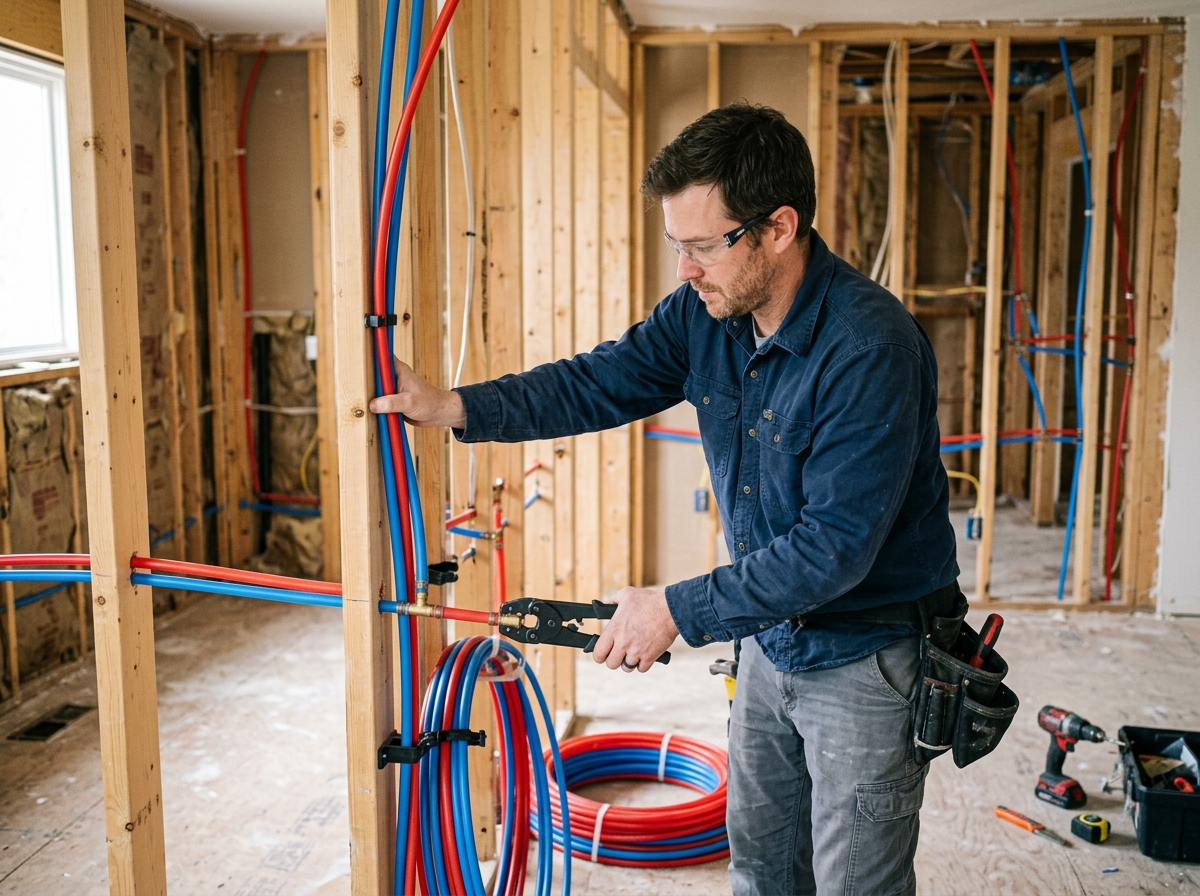
Our crew works room by room, installing new PEX-A or copper supply lines, connecting to a central manifold system for zone isolation, and capping old pipe as they go. Hot and cold lines are color-coded and labeled at the manifold. We typically complete a 3-bedroom home in 2–3 days. Fixtures are reconnected and tested as each zone is completed.
Inspection, Pressure Test, and Patch Coordination
We schedule the Washington County building inspection, which certifies the new pipe installation before we close any walls. After inspection approval, we pressure-test the full system at 100 PSI for 60 minutes. We coordinate drywall and paint patching with our trusted finishing partners, or we provide precise patch locations if you prefer to use your own contractor.
Compare Your Options
PEX-A vs. Copper for Whole-Home Repiping in Southern Utah
Both PEX-A and copper are excellent pipe materials, but Southern Utah's specific water chemistry and climate conditions create meaningful performance differences between them over a 20–30 year service life.
Our recommendation: For whole-home repiping in St. George, Hurricane, or any Washington County location on municipal hard water, PEX-A is our recommendation in virtually every case. The combination of hard-water scale resistance, freeze-expansion tolerance, and flexibility against clay soil movement makes it the superior long-term choice for our region's conditions. Copper is appropriate where code requires exposed visible pipe — utility rooms, mechanical spaces — and we often use copper for those sections in a hybrid installation.
The Marlin Difference
Why Southern Utah Trusts Marlin
46 Years of Washington County Repipe Experience
Marlin Plumbing has completed hundreds of whole-home repipes in Washington County across four decades of evolving pipe materials, building codes, and water quality conditions. We've repiped galvanized, copper, and polybutylene homes of every size — from 900-square-foot bungalows in downtown St. George to 5,000-square-foot custom builds in Bloomington Hills.
PEX-A Specialists in a Hard-Water Region
We recommend PEX-A (Uponor/Wirsbo expansion-fit system) for the vast majority of Southern Utah repipes. PEX-A has the highest flexibility rating among PEX grades, providing freeze-expansion resistance, excellent tolerance for soil movement, and a smooth interior bore that resists mineral scale significantly better than copper in our 15–25 gpg water.
Manifold System for Zone Isolation
Our repipes use a central manifold system that provides a dedicated shutoff for every fixture circuit in the home. If a future leak or fixture repair is needed, you shut off just that circuit — not the entire house. This is a meaningful quality-of-life upgrade that no partial pipe repair provides.
Permit and Inspection Included — No Exceptions
A whole-home repipe is the most significant plumbing change a home undergoes. Marlin Plumbing includes the Washington County permit and building inspection in every repipe proposal. Unpermitted repipes fail home inspection during sale and may void homeowner's insurance coverage on subsequent water damage claims.
Real Customers, Real Results
What Our Customers Say
“We had our third pinhole leak in 18 months in our 1987 St. George home. After the third one, Marlin sat down with us and walked through the repipe option honestly. The project cost $6,800 and took three days. Our water pressure is incredible now — we didn't realize how bad it had gotten. The manifold system is brilliant.”
— Nancy R.
St. George, UT
“We bought a 1979 home in Hurricane knowing it had galvanized pipes. Marlin gave us a realistic assessment and a competitive quote, started on a Monday, and had us fully operational by Wednesday. Their crew was tidy, professional, and courteous to our family the whole time. Best major home investment we've made.”
— Chris P.
Hurricane, UT
“Our home in Bloomington Hills had polybutylene pipe from the original 1991 construction. Our home inspector flagged it when we bought the house, and we got three quotes. Marlin was mid-range on price but by far the most thorough in their assessment and explanation. Their PEX-A manifold system is exactly what we wanted. Passed inspection first try.”
— Lisa K.
Bloomington, UT
Real Work, Real Results
Full Copper-to-PEX-A Repipe of a 1984 Bloomington Hills Home
The Problem
A homeowner in Bloomington Hills had experienced four pinhole leak repairs in a 1984 copper-piped home over 30 months, with repair costs totaling $2,800. Water pressure throughout the home had dropped from a tested 62 PSI at move-in to 41 PSI at the time of the repipe consultation, consistent with significant interior scale accumulation. The homeowner was preparing to list the property for sale and needed a lasting solution that would pass a buyer's inspection.
Our Solution
Marlin Plumbing completed a full whole-home repipe of all supply lines using Uponor PEX-A with a central 14-circuit manifold installed in the garage utility space. The project required 18 small access cuts through drywall, all patched and textured by our finishing partner within 4 days of the repipe completion. Washington County inspection was completed on day 3 of the project. We ran the new PEX lines primarily through the attic space to minimize wall penetrations, with dedicated hot and cold runs to every fixture.
The Result
Completed in 3 working days. Post-installation pressure test: 58 PSI at all fixture locations — a 42% pressure improvement over pre-repipe levels. The home sold 45 days later with zero plumbing contingencies in the buyer's inspection report. Total project cost was $7,200; the homeowner's agent confirmed the repipe documentation increased the sale price by an estimated $8,000–$10,000 over comparable properties without documentation of recent plumbing updates.
Related Services
Customers who needed this service also needed these.
Got Questions?
Whole-Home Repiping FAQ
Answers from our certified technicians — based on the questions St. George homeowners ask most.
Whole-home repipes in Washington County typically run $4,500–$7,500 for homes up to 2,000 square feet with PEX-A, and $7,500–$12,000 for larger homes or those requiring copper installation. Homes with difficult access (slab foundations, two-story structures, minimal attic space) are at the higher end. The Washington County permit fee is included in our proposal.
Whole-Home Repiping Across Southern Utah
Serving St. George and the surrounding Washington County communities since 1978.
Need Whole-Home Repiping?
Call us 24/7 for same-day service. Free estimates on all projects. No hidden fees, no surprises — just honest work from a team that's served St. George since 1978.
Family Owned & Operated • 48+ Years • Licensed & Insured • Certified Experts