
Leak Detection in St. George, UT
Non-invasive electronic and acoustic leak detection locates hidden pipe leaks under slabs, inside walls, and behind landscaping — before they become catastrophic. Marlin Plumbing has protected Southern Utah homes since 1978.
Get a Free Estimate
We'll call within the hour.
No spam. Licensed & insured. Free estimates, always.
47+
Years
Serving Southern Utah
Certified
Technicians
Industry-Trained Pros
4.9
Star Rating
500+ Google Reviews
24/7
Available
Emergency Response
100%
Licensed
& Fully Insured
Free
Estimates
No Hidden Fees Ever
Advanced Leak Detection for St. George's Slab Foundations and Desert Landscapes
Marlin Plumbing's leak detection service starts with the meter and works systematically to the source — we don't guess, we trace. Our equipment is maintained and calibrated to manufacturer specification, and our technicians have years of Southern Utah field experience interpreting acoustic and thermal data in slab and desert-soil conditions. After detection, we provide a burst pipe repair or slab repair recommendation with transparent pricing so you can make an informed decision without pressure.
For homes where slab leaks are a recurring issue, we often recommend a whole-home repiping assessment. Replacing aging copper under the slab with PEX routed through the conditioned space eliminates the slab leak risk entirely — and in homes with multiple prior leak repairs, it often proves more economical than ongoing slab patch repairs.
Finding Leaks Before They Find You
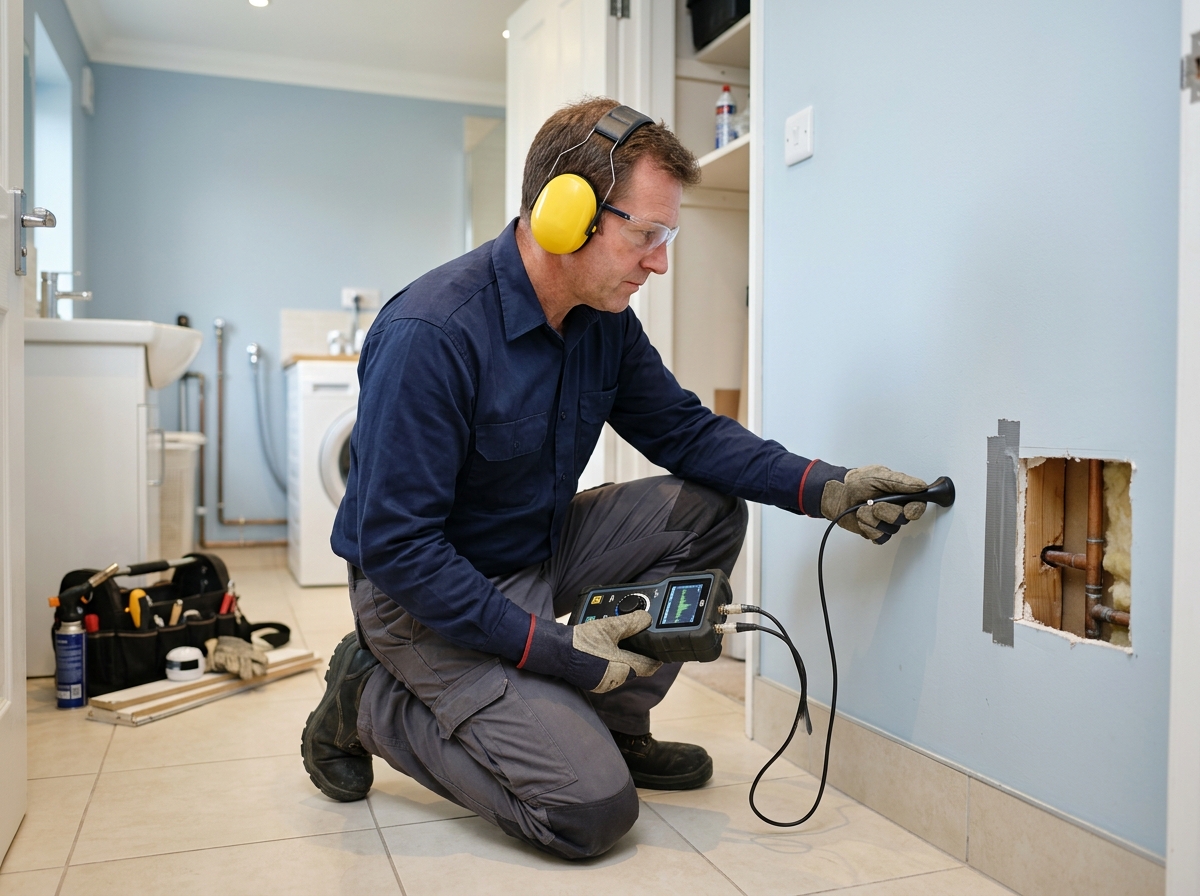
A hidden leak doesn't announce itself until it's done significant damage — swollen drywall, mold behind tile, a yard that won't stop being wet, or a water bill that doubled for no apparent reason. Our leak detection service uses acoustic listening equipment, electronic amplification, thermal imaging, and tracer gas to pinpoint leak locations with precision — often to within a few inches — before opening a single wall or cutting a slab.
The combination of slab-on-grade construction and Washington County's clay-rich soil makes leak detection in St. George particularly challenging. Leaking water under a slab can migrate significant distances before surfacing, making visual detection unreliable. Our equipment finds the source, not where the water appears — saving you from costly exploratory demolition.
- Acoustic and electronic leak detection for walls, slabs, and yards
- Thermal imaging to locate concealed moisture
- Tracer gas testing for pressurized supply lines
- Slab leak location without exploratory cutting
- Irrigation and outdoor supply leak pinpointing
- Full written report with leak location and recommended repair
Service Details
Quick Info
Timeline
2–6 hours
Warranty
Leak location guaranteed
Availability
24/7 Emergency
Know the Warning Signs
Signs You Need Leak Detection
Catching these early prevents a small issue from becoming a costly emergency.
A single month's water bill 30% or more above your normal baseline is the most common first indicator of a hidden leak. In St. George where irrigation use fluctuates seasonally, compare to the same month the prior year. A consistent climb over 3–4 bills with no change in usage is a strong signal.
In slab-foundation homes, a hot water line leak under the slab will radiate heat through the concrete. If you feel an unusually warm area of flooring — especially tile or concrete — with no obvious heat source above, it's a classic indicator of a hot water slab leak.
If you can hear water moving inside walls or under the floor when every faucet, toilet, and appliance is off, there is an active pressurized leak somewhere in your system. This warrants immediate leak detection.
A saturated area of yard that doesn't dry between irrigation cycles, or that's wet when irrigation hasn't run, usually indicates a mainline or irrigation supply leak underground. In St. George's dry desert climate, wet soil that isn't explained by recent rain is almost always a pipe issue.
Clay soil in Washington County expands significantly when saturated and contracts when dry. A long-term slab leak cycles this expansion and contraction repeatedly, eventually causing slab cracking, door and window frame racking, and floor unevenness. If you're seeing new cracks, test for leaks before calling a foundation company.
Mold requires sustained moisture. If you smell mildew in an area without a known water source — particularly in bathrooms, under sinks, or along exterior walls — a concealed pipe or fitting leak is a primary suspect.
Local Expertise
Why Slab Leaks Are More Common in Washington County
St. George sits on some of the most reactive clay soil in Utah. When the desert receives moisture — from rain, irrigation, or a pipe leak — the clay swells measurably, then shrinks and cracks as it dries out. Pipes buried in this soil are subject to constant lateral and vertical movement, creating stress concentrations at joints and elbows that wouldn't affect pipes in more stable soil conditions.
Layer on top of that Washington County's water hardness of 15–25 grains per gallon. Over decades, copper pipes exposed to this mineral content develop pinhole corrosion from the inside, particularly at low points and horizontal runs where mineral-laden water sits. The combination of external soil movement and internal corrosion explains why St. George has a significantly higher rate of slab leak calls than plumbers see in softer-water, more stable-soil markets.
Neighborhoods like Entrada and Coral Canyon, built largely in the 2000s on sites with significant engineered fill, present a different challenge — fill material compacts unevenly over time, creating settlement that stresses supply lines in unpredictable ways. Meanwhile, older neighborhoods in central St. George and Leeds have copper pipe systems approaching 40–50 years of age in aggressive water conditions. We see both failure modes regularly and have calibrated our detection approach to each.
Transparent from Start to Finish
How Our Service Works
Meter Test and Pressure Diagnostic
We start at the water meter with a static pressure test and a meter movement check to confirm a leak is present and to quantify the approximate loss rate. This establishes baseline data and confirms whether the leak is in the supply system, the irrigation system, or the sewer system.
Electronic and Acoustic Scanning
Using calibrated acoustic ground microphones and electronic amplifiers, we scan the area where the leak is most likely located — typically following the pipe route from the meter to the building. We listen for the distinctive pressure-frequency signature of a leak through concrete, soil, and wall framing.
Thermal and Visual Confirmation
Once we've acoustically identified a candidate location, we confirm with thermal imaging (for hot water leaks) or tracer gas injection (for cold water lines) to nail the precise location before recommending any excavation or demolition. We document findings photographically.
Written Report and Repair Recommendation
You receive a written summary of the detected leak location, the detection method used, and our recommendation for repair — including whether the repair involves slab cutting, wall access, or trenchless methods. Repair can typically be scheduled immediately following detection.
Compare Your Options
Slab Leak Repair Options: Access vs. Reroute
Once a slab leak is located, homeowners typically have two repair options. Here's how they compare for St. George homes.
Our recommendation: For a first slab leak in a home with pipe under 30 years old, direct slab access is usually the most cost-effective approach. For a second or third leak, or for homes with 40+ year-old copper under the slab, rerouting the supply line through the walls eliminates the risk of ongoing slab failures.
The Marlin Difference
Why Southern Utah Trusts Marlin
Non-Invasive Before Any Demolition
We don't cut slabs or open walls to find leaks — we find the leak precisely first, then recommend the minimum necessary access to complete the repair. This saves you from the cost and mess of exploratory demolition that can run $1,000–$3,000 before the actual repair even starts.
Southern Utah Slab Expertise
Washington County's combination of slab-on-grade construction and clay soil creates specific leak behavior that requires local experience to interpret correctly. We've located hundreds of slab leaks throughout St. George, Hurricane, and Washington City — we know how water moves in this ground.
Integrated Detection and Repair
Most leak detection companies find the leak and then leave you to hire a plumber for the repair. We do both — detection, repair, and follow-up verification in a single working relationship. No handoff confusion, no gaps in accountability.
Certified Precision
Our leak detection technicians are certified plumbers, not detection specialists who hand off to a different crew. They understand pipe systems, repair methods, and the implications of what they're finding — giving you a more accurate diagnosis and repair recommendation.
Real Customers, Real Results
What Our Customers Say
“My water bill went from $90 to $240 in one month. Marlin found a slab leak under my living room floor in about two hours without touching a single tile. Repair was done the next day. Incredible service.”
— Paul N.
St. George, UT
“We had a persistent wet spot in the yard in Bloomington Hills that had been there for two summers. Two other plumbers said it was irrigation but couldn't find the break. Marlin found a supply line leak 14 feet away from where the moisture was surfacing. Fixed same day.”
— Sandra K.
Bloomington, UT
“Felt a warm spot on our tile floor for months and ignored it. Finally called Marlin — they found a hot water slab leak in 90 minutes. The repair saved us from what the technician said could've been significant foundation damage if we'd waited another year.”
— Marcus L.
Hurricane, UT
Real Work, Real Results
Entrada Home: Slab Leak Diagnosed 8 Feet from Where Water Surfaced
The Problem
A homeowner in Entrada noticed water wicking through a tile grout line in their hallway. Two plumbers had previously cut into the slab at the wet spot without finding the pipe failure, leaving two patched slab cuts and an unresolved leak — resulting in over $3,000 in failed repairs.
Our Solution
Marlin used acoustic detection equipment to trace the supply line route and identified a pressure anomaly 8 feet east of the wet tile — at an elbow fitting that had corroded from the inside. One targeted slab cut exposed the failed elbow, which was replaced with a new copper section and pressure-tested.
The Result
The leak was resolved on the first Marlin visit. The homeowner's water bill returned to baseline the following month, and no moisture recurrence has been detected at the 12-month follow-up. The homeowner is now evaluating a full slab-to-wall reroute given the age of the remaining copper.
Related Services
Customers who needed this service also needed these.
Got Questions?
Leak Detection FAQ
Answers from our certified technicians — based on the questions St. George homeowners ask most.
Pressurized water escaping through a pipe crack or failed joint creates a distinctive sound frequency as it contacts surrounding material. Our acoustic ground microphones are calibrated to detect this frequency through concrete slabs, packed soil, and building materials. We move systematically along the pipe route, comparing signal strength to triangulate the leak's exact location. For cold water lines where acoustic detection is more difficult, we can inject a non-toxic tracer gas that escapes at the leak point and is detected with a sensitive surface probe.
Leak Detection Across Southern Utah
Serving St. George and the surrounding Washington County communities since 1978.
Need Leak Detection?
Call us 24/7 for same-day service. Free estimates on all projects. No hidden fees, no surprises — just honest work from a team that's served St. George since 1978.
Family Owned & Operated • 48+ Years • Licensed & Insured • Certified Experts