

Burst Pipe Repair in St. George, UT
A burst pipe can dump hundreds of gallons into your home in minutes. Marlin Plumbing has responded to pipe failures across Washington County since 1978 — we arrive fast, stop the damage, and restore your water supply the same day.
Get a Free Estimate
We'll call within the hour.
No spam. Licensed & insured. Free estimates, always.
47+
Years
Serving Southern Utah
Certified
Technicians
Industry-Trained Pros
4.9
Star Rating
500+ Google Reviews
24/7
Available
Emergency Response
100%
Licensed
& Fully Insured
Free
Estimates
No Hidden Fees Ever
Emergency Burst Pipe Repair Across Southern Utah
Burst pipes are one of the most damaging emergencies a St. George homeowner can face. Water escaping at main supply pressure (typically 60–80 PSI in Washington County) can discharge 8–12 gallons per minute — enough to saturate drywall, flooring, and insulation within the first hour. Marlin Plumbing has handled pipe failures of every type since 1978, from small pinhole leaks in Bloomington condominiums to catastrophic main line breaks at commercial properties in the St. George Boulevard corridor. We pair that field experience with modern acoustic leak detection equipment so we locate and repair the break correctly on the first visit. Our emergency plumbing team is available around the clock.
Not every pipe failure is immediately obvious. Many St. George homeowners discover a burst pipe only when their water bill arrives or when a slow seep has already caused structural damage inside a wall. Our leak detection service uses non-invasive listening equipment and thermal imaging cameras to find hidden moisture without unnecessary demolition. If the pipe failure is symptomatic of broader deterioration — particularly in homes built before 1990 with original galvanized or polybutylene plumbing — we may recommend evaluating whole-home repiping to address the underlying condition rather than repeatedly patching an aging system.
Why Pipes Burst in Southern Utah Homes
St. George's climate creates a uniquely challenging environment for residential plumbing. While the region rarely sees hard freezes, the few nights each winter that dip below 28°F are enough to burst copper and CPVC supply lines in garage walls, crawl spaces, and exterior-facing wall cavities — especially in homes built before 1995 that lack adequate pipe insulation. We see the largest surge in burst-pipe calls in January and February, particularly in neighborhoods like Little Valley and Bloomington Hills where newer custom homes have longer pipe runs through uninsulated attic spaces.
Washington County's expansive clay soil compounds the problem underground. When the desert absorbs monsoon rainfall (July through September), the clay swells and shifts, placing lateral stress on buried water mains and service lines. Hairline cracks develop under that load and fail catastrophically when water pressure cycles spike — often in the early morning hours when demand drops and static pressure climbs. Our certified technicians are trained to identify both in-wall failures and underground breaks using acoustic leak detection so we repair the right section on the first visit.
- 24/7 emergency dispatch — technician en route within 60 minutes
- Acoustic and thermal leak detection to pinpoint the break
- Full pipe segment replacement, not just patch repairs
- Water extraction coordination with restoration partners
- Pressure test after every repair to confirm integrity
- certified work meets Washington County code
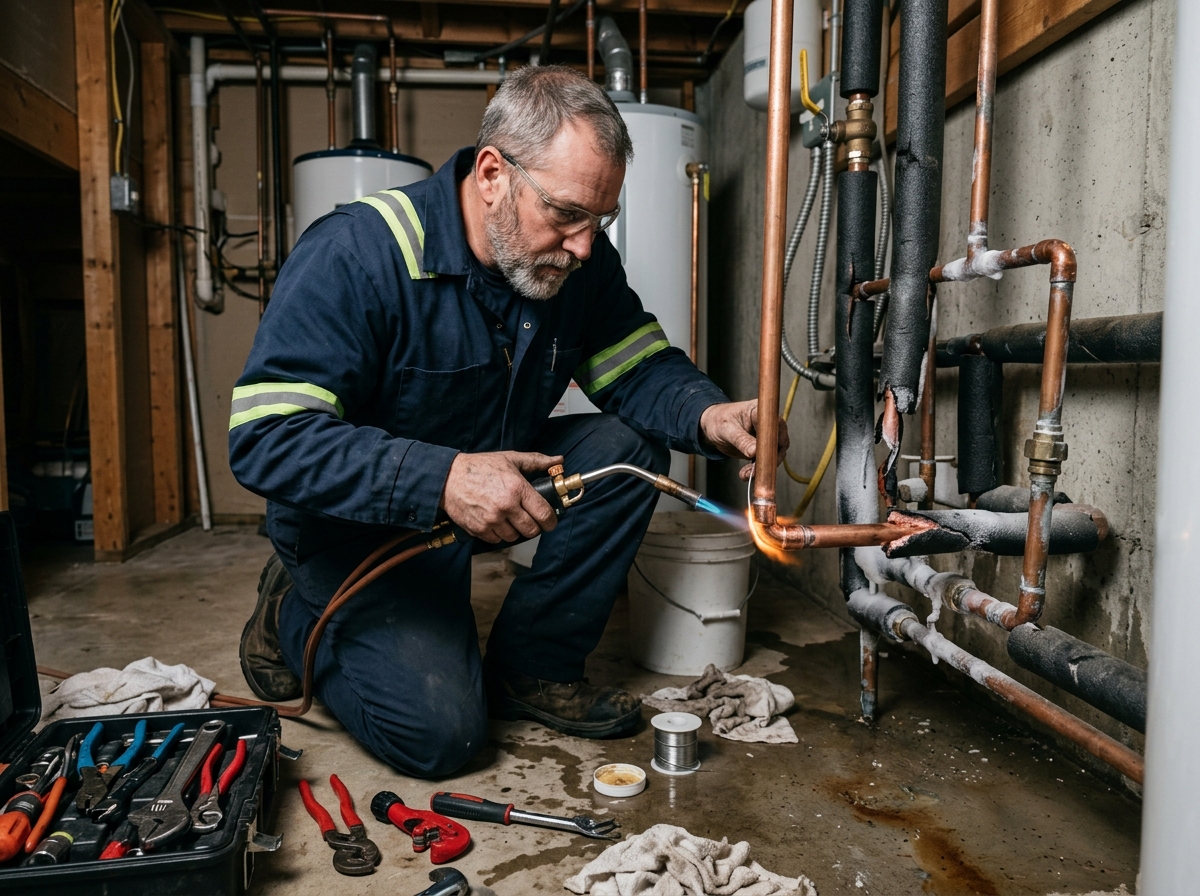
Service Details
Quick Info
Timeline
Same day
Warranty
2-year labor
Availability
24/7 Emergency
Know the Warning Signs
Signs You Need Burst Pipe Repair
Catching these early prevents a small issue from becoming a costly emergency.
If pressure drops to a trickle at every fixture simultaneously, water is escaping somewhere between the meter and your home — a classic indicator of a main line or supply pipe rupture.
Shut off every valve and check your meter dial. Any movement confirms an active leak in the buried or in-wall pipe system. Even slow movement represents thousands of gallons per month.
A hissing, dripping, or rushing sound inside drywall or under flooring when no fixtures are in use is a reliable sign of a pipe leak. In St. George's dry climate, evaporation can mask the moisture before visible staining appears.
Moisture stains, drywall bubbles, or soft flooring that appeared overnight indicate water is saturating building materials. Southern Utah's low humidity can dry the surface while the framing stays wet and begins to mold.
A bill 30% or more above your baseline during a period of normal usage almost always points to a hidden leak. Check irrigation controllers as well — solenoid failures are common during our 110°F summers.
Brown or orange-tinted water after a suspected pipe failure indicates that air has entered the line and is oxidizing the pipe interior. This is especially common in older galvanized steel pipes that are overdue for replacement.
Local Expertise
How Southern Utah's Climate and Soil Affect Burst Pipe Risk
St. George's reputation as a desert city leads many homeowners to underestimate pipe freeze risk — a costly misconception. Washington County averages 8–12 nights per winter with temperatures dropping below 28°F, the threshold at which standing water in uninsulated pipe sections begins to expand and fail. Homes in Bloomington Hills, Sunbrook, and Little Valley with pipe runs through attached garages, vented crawl spaces, or attic-mounted pressure regulators are particularly vulnerable. The 45°F overnight temperature swings that occur between December and February create repeated freeze-thaw cycles that fatigue copper fittings even when they don't fully freeze.
The region's famous hard water — consistently 15–25 grains per gallon from the Virgin River watershed — deposits calcium and magnesium scale inside copper and galvanized pipes over years of service. This scaling narrows the effective bore diameter and concentrates water pressure against the pipe wall at elbows, tees, and solder joints. When a freeze event occurs, the pipe wall at a scaled section has less flexibility to absorb expansion stress, making it far more likely to split than a clean, untreated pipe. Homes on municipal water in the downtown St. George core without a whole-home water softener frequently see premature pipe failures in the 20–30 year range.
Underground pipe failures in Washington County follow a predictable seasonal pattern tied to the monsoon. July through September monsoon rains saturate the region's expansive clay soil, causing it to swell 3–6% by volume. Service lines and buried copper feed pipes experience significant lateral compression during these swells. When the soil dries and contracts in October and November, any microcracks in the pipe wall propagate. The result is a wave of underground burst-pipe calls each December and January — pipes that were stressed all summer finally fail when winter pressure cycling removes the last margin. Our familiarity with this pattern means we arrive already knowing where to look.
Transparent from Start to Finish
How Our Service Works
Emergency Dispatch and Water Shutoff
We answer 24/7. When you call (435) 287-4445, our dispatcher locates the nearest available technician and routes them to you. While you wait, we walk you through shutting off the main supply valve to halt flooding. Most St. George addresses have the shutoff at the curb near the meter box.
Leak Isolation and Damage Assessment
Our tech uses acoustic listening equipment and thermal imaging to trace the pipe run and confirm the exact failure point — without opening walls unnecessarily. We assess water migration into adjacent framing, insulation, and flooring so you have a complete picture before work begins.
Full Pipe Section Replacement
We remove the damaged pipe segment and replace it with code-compliant materials — typically PEX-A in wall cavities (excellent freeze resistance) or schedule 40 copper where local inspectors require it. We never patch burst pipes with compression fittings alone; the compromised section comes out.
Pressure Test and System Restore
Before closing any wall or trench, we pressure-test the repaired section at 150 PSI for 30 minutes. Once the line holds, we restore water supply, flush the system, and verify pressure and flow at representative fixtures. You get a written report suitable for homeowner's insurance claims.
Compare Your Options
Patch Repair vs. Full Pipe Section Replacement
When a pipe fails, homeowners face a choice: apply a temporary patch or replace the damaged section. Here's how those options compare for Southern Utah conditions.
Our recommendation: We strongly recommend full section replacement over patch repairs for any burst pipe in Southern Utah. Washington County's expansive clay soil and hard water (15–25 gpg) accelerate corrosion on stressed pipe sections, making a patched line highly likely to fail again nearby within the year. The additional upfront cost of a proper repair is almost always recovered in avoided water damage and a second service call.
The Marlin Difference
Why Southern Utah Trusts Marlin
46 Years Serving Washington County
Marlin Plumbing has operated in St. George since 1978 — long before the population boom that brought hundreds of thousands of new residents to Washington County. We know the soil conditions, the water chemistry, and the builder shortcuts that cause premature failures in local homes.
Certified, Licensed, and Insured
Every technician carries certification and holds a current Utah plumbing contractor's license. Our insurance covers your property if anything goes wrong during repairs — a protection you lose when you hire an unlicensed handyman.
Stocked Trucks, First-Visit Fix Rate
Our service trucks carry PEX-A, copper, CPVC, and fitting inventories sized for the most common residential pipe diameters in Southern Utah. We complete the vast majority of burst-pipe repairs in a single visit — no waiting 48 hours for a parts run.
Insurance Documentation Included
We provide before-and-after photos, a detailed scope of work, and a signed repair certificate with every emergency job. Homeowner's insurers covering water damage require this documentation — we make the claims process as painless as the repair.
Real Customers, Real Results
What Our Customers Say
“Our main supply line burst at 2 AM on a January night — the kind of night St. George actually gets cold. Marlin had a tech at our house within 45 minutes. He found the break in the garage wall, replaced a four-foot section of pipe, and had our water back on before sunrise. Absolutely phenomenal response.”
— Kevin M.
St. George, UT
“I noticed my water bill jumped from $80 to $310 with no explanation. Marlin came out, used some kind of acoustic device, and found a pinhole in a pipe running under my slab. They were upfront about the cost before they started, fixed it clean, and filed the paperwork I needed for my insurance claim.”
— Sandra T.
Hurricane, UT
“The clay soil in our neighborhood had been shifting all summer and it finally cracked our service line right at the foundation. Marlin dug it up, replaced the whole run from the meter to the house with PEX, and backfilled it the same day. Price was fair and the crew was respectful of the landscaping.”
— Dale R.
Bloomington, UT
Real Work, Real Results
Slab Leak Repair After Clay Soil Movement in Sunbrook
The Problem
A homeowner in the Sunbrook subdivision noticed their foundation slab was damp in two areas and their water bill had doubled over three months. A previous plumber had suspected a minor leak but couldn't locate it without tearing up tile. The homeowner called Marlin Plumbing after the situation deteriorated following the September monsoon season.
Our Solution
Our technician deployed an acoustic ground microphone and traced two separate micro-fractures in the 3/4-inch copper hot-water line running beneath the slab — stress cracks consistent with clay soil lateral movement. Rather than cutting through 40 square feet of tile to access the damaged run, we rerouted the hot-water line through the attic and down through interior walls, eliminating the under-slab exposure entirely and bringing the installation up to current Washington County code.
The Result
Water usage dropped from 18,000 gallons per month to 6,200 gallons — a 66% reduction. The homeowner's insurance covered $4,800 of the $6,500 project cost. The rerouted line carries a 2-year labor warranty and is unaffected by future soil movement.
Related Services
Customers who needed this service also needed these.
Got Questions?
Burst Pipe Repair FAQ
Answers from our certified technicians — based on the questions St. George homeowners ask most.
We dispatch within minutes of your call and target a 60-minute arrival time anywhere in Washington County. St. George, Hurricane, La Verkin, and Toquerville are all within our primary service radius. Remote areas like Leeds may take slightly longer, but we'll give you an honest ETA when you call.
Burst Pipe Repair Across Southern Utah
Serving St. George and the surrounding Washington County communities since 1978.
Need Burst Pipe Repair?
Call us 24/7 for same-day service. Free estimates on all projects. No hidden fees, no surprises — just honest work from a team that's served St. George since 1978.
Family Owned & Operated • 48+ Years • Licensed & Insured • Certified Experts